





Feed On Offer, commonly abbreviated to FOO, is the weight of the pasture cut to ground level and dried to remove all water. Water in pasture has no nutritional value so when relating the quantity of feed on offer or energy content of pasture or supplement to what the animal can eat and utilise, water must be ignored.
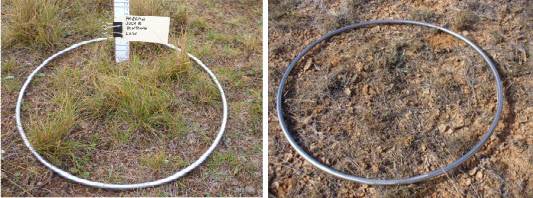
To measure FOO, pasture within a 0.1 sq m quadrant is cut right to ground level and dried in an oven until a constant weight is reached indicating all water is removed. The weight in grams of the dried pasture from 0.1 sq m is multiplied by 100 to give the equivalent in kg/ha, ie 15 g harvested from a 0.1 sq m quadrant is equal to 1500 kg/ha. FOO can be expressed in tonne/ha (1.5 t/ha) or in kg/ha (1500 kg/ha). In this FOO Library, all results are expressed in kg/ha dry matter.
Quadrants before and after cutting
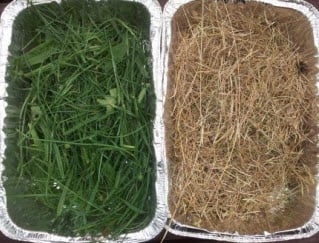
FOO can refer to Total FOO (Green and Dead pasture combined) or just the Green or Dead pasture. In this library, the pasture cut from each quadrant has been sorted into Green and Dead and the weight in kg/ha for each component is shown separately. To estimate animal intake and performance, both the Green and Dead FOO levels and the nutritive value of each component need to be known.
For the FOO library, all samples were sorted by hand into green and dead to allow estimation of yield and nutritive value of each component. Green included leaves stems and flower head provided they were green at the time of harvest.
Green and dead pasture after sorting
The photos in this library can be compared with the pastures on your property. Look at the height, density, species and ground cover to find pictures that match the pastures on your farm.